Submitted by zenno on Sun, 04/03/2011 - 19:25
The tightly sealed, hollow stem of a small cream jug presents collectors from two different fields with quite a problem — no less than a coinundrum
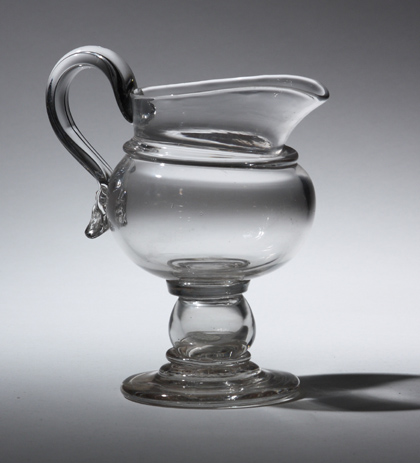
Trapped within is a rare, nearly uncirculated 1831 United States five cent coin, known to collectors as a "capped bust half dime."
Submitted by zenno on Sat, 03/12/2011 - 21:32
An odd looking sugar bowl, bearing a distant family resemblance to the rare mold blown masterpieces of 1820s New England, was a welcome substitute for collectors of lesser means in the 1930s, and was put onto the market for that very purpose.
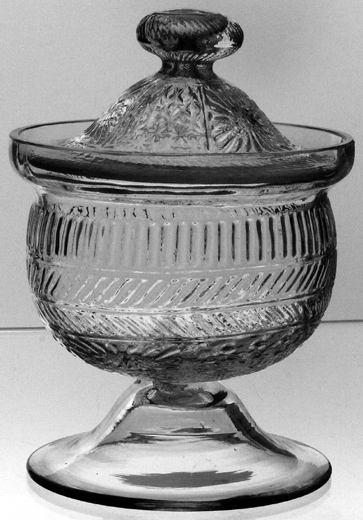
However, the same cannot be said for this bowl:
Submitted by zenno on Mon, 01/10/2011 - 23:02
A stork stands on a rocky shore, surrounded by tall grasses and grasping a favorite delicacy in its beak — a small, still writhing snake. An extraordinarily rich red shading down to yellow amber sets a mood of evening, of a brilliant sunset.
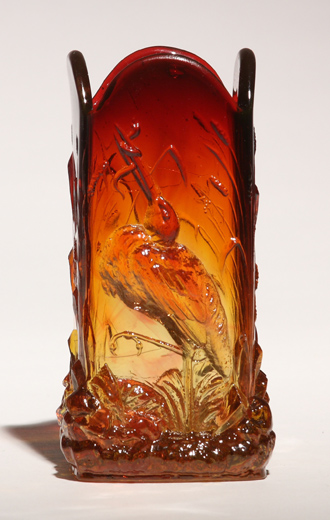
Long considered one of the most desirable forms among collectors of American art glass, this vase is all the more remarkable because it was machine pressed, in a mold. But why?
Submitted by zenno on Sat, 01/08/2011 - 19:32
As rare as hen's teeth, this 5 1/4" high amber Ohio flask has a pattern known to collectors as "popcorn."
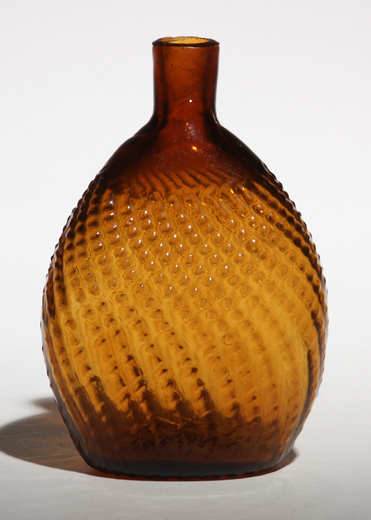
Blowers got considerable mileage from an ancient tool — a small, cup-shaped mold surrounded by deep vertical grooves.
Submitted by zenno on Sat, 10/02/2010 - 15:16
A green and green amber flask with scroll borders shows that bottle makers considered it more than reasonable to advertise themselves prominently on their products.
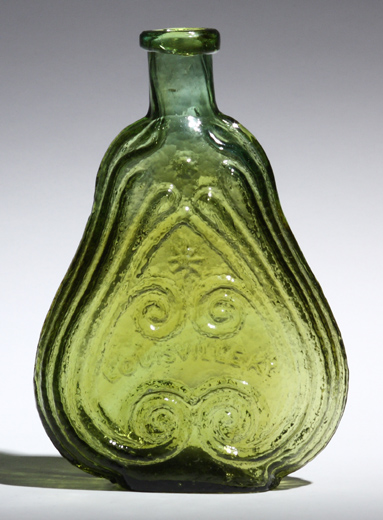
This particular flask announces that it was made at the Louisville Glass Works, in Louisville, Kentucky, which operated between 1855 and 1874 in a factory opened in 1850 by the Kentucky Glass Works.
Submitted by zenno on Mon, 09/20/2010 - 23:12
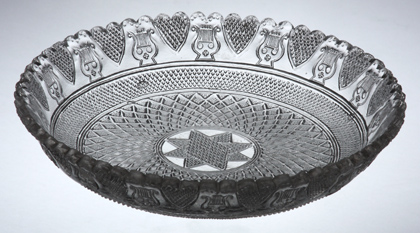
The fashionable heart and lyre border and wide field of strawberry diamonds conceal the experimental nature of this rare example of early American pressing.
Submitted by zenno on Mon, 09/20/2010 - 22:27
A pair of finger bowls made and decorated in New York City in the 1850s or 1860s help clear up a lingering question about the removal or modification of engraved decoration.
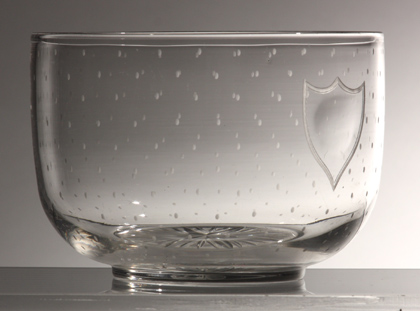
The curator's question was simple: "Could that monogram have been added on top of another?"
Submitted by zenno on Thu, 01/07/2010 - 03:26
Tall, elegant and colorful, this vase with rock crystal engraving is of a kind presented in 1903 by its manufacturer to the Pennsylvania Museum and School of Industrial Design as an example of its very best.
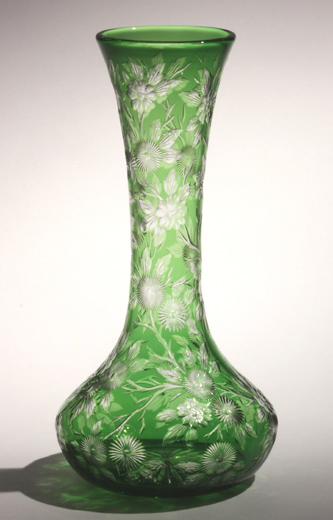
Rock crystal relates this highly polished decoration to that found on Renaissance and Baroque objects cut from naturally occurring crystal — a near colorless and transparent quartz that could also be highly polished.
Submitted by zenno on Mon, 09/07/2009 - 03:09
Two strikingly similar blown and cut nine inch tall pitchers left a Midwestern glasscutter's shop together in the 1840s, marked as a pair.
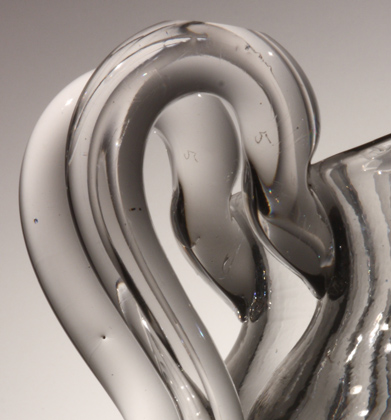
Each is marked with a small scratched number '5' to the right of its upper handle attachment.
Submitted by zenno on Thu, 01/08/2009 - 21:59
An extremely rare opalescent fruit basket made in New England about 1840 emulates porcelain twice — in form and color — and in some ways surpasses it.
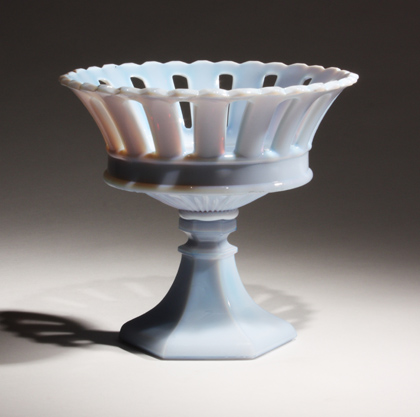
With open sides consisting of ribbons of glass it emulates a form long known in porcelain. Porcelain fruit baskets were popular in early Federal period America. They were both imported from Europe and made by America's most successful porcelain manufacturer of the period, the Tucker factory of Philadelphia.
Pages


